
For decades, fat loss has been reduced to one oversimplified
and damaging idea:
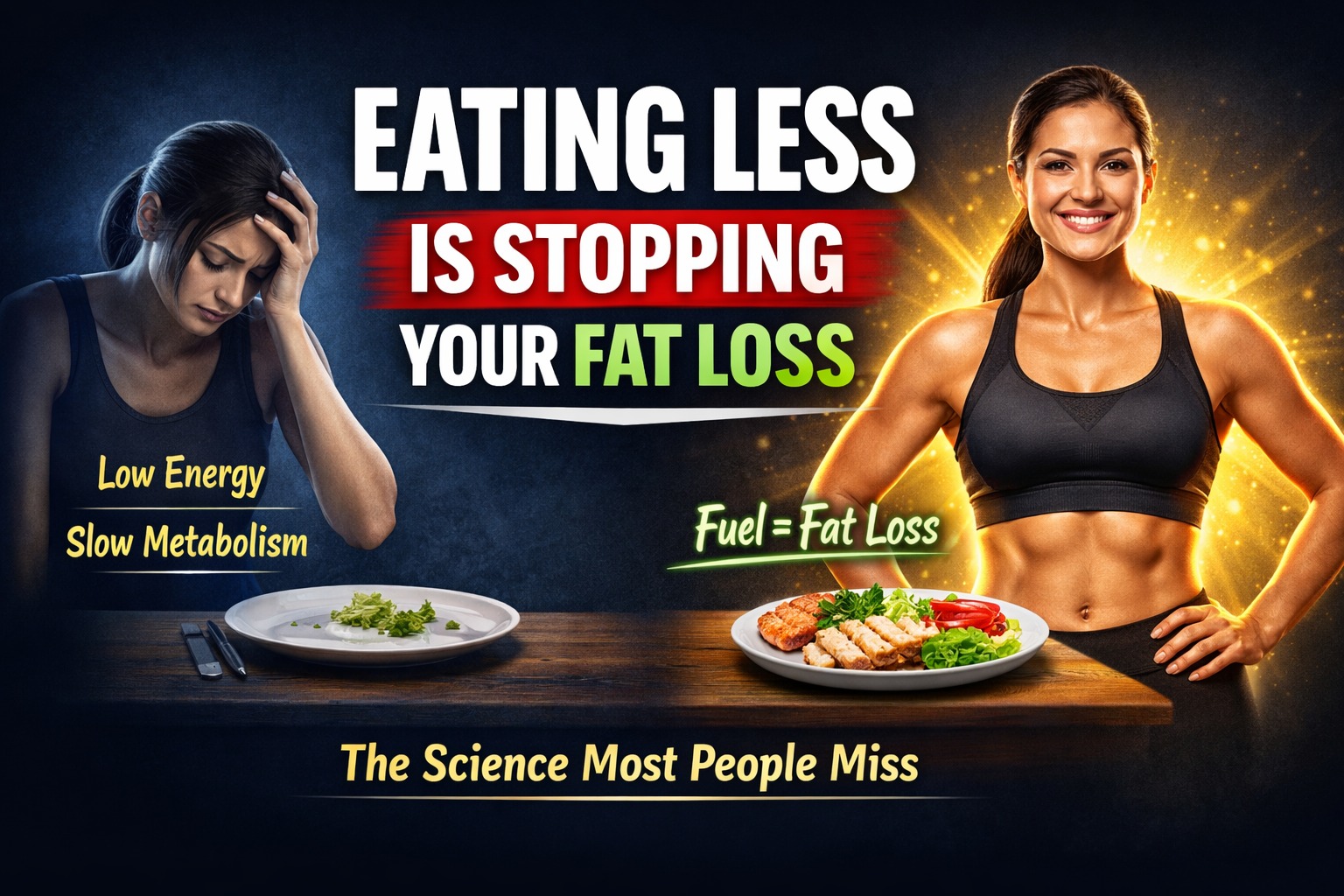
“Eat less to lose fat.”
So people start skipping meals.
They slash portions aggressively.
They starve themselves Monday to Friday.
And then they wonder:
- why fat loss stalls
- why energy disappears
- why belly fat refuses to move
- why weight comes back faster than it went
Here is the uncomfortable, science-backed truth:
Eating too little is one of the biggest reasons fat loss stops.
This is not motivation.
This is physiology, metabolism, and real-world coaching
reality—especially in Indian lifestyles.
The Biggest Fat-Loss Myth: Less Food = More
Fat Loss
On paper, the logic sounds perfect: - Eat less → fewer calories
- Fewer calories → weight loss
And yes, initially, the scale does move.
But this is where most people get trapped.
Weight loss is not fat loss.
When food intake drops too aggressively, the body does not
politely burn fat.
It adapts for survival.
And survival physiology is ruthless.
What Actually Happens When You Eat Too
Little
The human body evolved to survive famine—not to look lean
year-round.
When calories fall too low, your body does not see a “fat-loss
phase.”
It sees a threat.
- Metabolism Slows Down (Adaptive
Thermogenesis)
With aggressive calorie restriction:
- Resting metabolic rate decreases
- Thyroid hormone activity reduces
- Energy expenditure drops
This is known as adaptive thermogenesis.
In simple terms:
You burn fewer calories things you used to do before.
This is why fat loss stalls even when food keeps decreasing.
- The Body Enters Survival Mode
In survival mode, the body prioritizes:
- energy conservation
- fat storage
- muscle breakdown
Muscle tissue is metabolically expensive.
Fat tissue is metabolically cheap.
So when calories are too low: - muscle loss increases
- fat is protected
This is the exact opposite of effective fat loss.
- Hormones Get Disrupted
Under-eating creates a hostile hormonal environment.
- Leptin (satiety hormone) drops → you never feel satisfied
- Ghrelin (hunger hormone) rises → cravings intensify
- Cortisol (stress hormone) increases → belly fat storage
increases
This hormonal state actively resists fat loss.
- Energy, Focus, and Motivation Collapse
Chronic low-calorie intake leads to:
- constant fatigue
- brain fog
- irritability
- poor workout performance
- loss of motivation
When energy drops, movement drops automatically.
And less movement means:
fewer calories burned, even without realizing it.
Why Weight Drops Initially (But Fat Doesn’t)
Many people argue:
“But I lost 3–4 kg by eating less.”
That early drop usually comes from: - water loss
- glycogen depletion
- muscle tissue
Not body fat.
That’s why: - the body still looks soft
- belly fat remains
- strength decreases
- fat loss plateaus
And once normal eating resumes, weight rebounds—often as
fat.
The Indian Diet Problem Makes This Worse
In Indian households, “eating less” usually means: - cutting protein first
- skipping meals
- reducing portions without nutrient balance
Most Indians already struggle with: - low protein intake
- high carbohydrate dependency
So further calorie restriction leads to: - even lower protein intake
- accelerated muscle loss
- constant hunger
- poor satiety
This sets the stage for binge–restrict cycles.
Why Eating Less Increases Cravings and
Binge Eating
Starvation does not build discipline.
It builds rebound behavior.
A familiar pattern:
- Eat very little for a few days
- Hunger and cravings build silently
- Stress or a social event hits
- Overeating or binge eating occurs
- Guilt follows
- Diet restarts again (“Monday se”)
This cycle destroys consistency—not fat.
Fat Loss Is Not About Eating Less, It’s About
Eating Right
Sustainable fat loss requires:
- adequate calories
- sufficient protein
- balanced meals
- consistent routines
When you eat enough: - metabolism stays active
- muscle mass is preserved
- hormones stabilize
- energy improves
- cravings reduce
Fat loss stops being a fight.
Why the Right Amount Matters More Than
the Less Amount
Two people can eat the same calories and get very different
results.
Because fat loss depends on: - nutrient composition
- protein intake
- meal timing
- daily movement (NEAT)
- sleep quality
- stress levels
When the body trusts that food is available, it is more willing
to release stored fat.
What Actually Works for Fat Loss
(Scientifically)
Real fat loss is boring—but effective.
- Adequate Protein
Preserves muscle, improves satiety, supports metabolism. - Mild Calorie Deficit
Enough to lose fat, not enough to trigger survival mode. - Daily Movement
Walking, steps, and general activity—not just gym workouts. - Strength Training
Protects muscle and improves insulin sensitivity. - Consistency Over Perfection
Repeatable habits beat extreme plans every time.
Why Most People Stall After Initial Weight
Loss
Fat loss stalls because:
- calories are already too low
- protein intake is insufficient
- muscle mass has dropped
- movement has reduced
- hormonal stress has increased
The solution is rarely:
“Eat even less.”
More often, the solution is:
Eat smarter, not smaller.
The Psychological Damage of Chronic UnderEating
Long-term under-eating creates: - fear of food
- guilt after meals
- obsessive calorie tracking
- loss of trust in hunger cues
This damages your relationship with food—and fitness.
True transformation should create control and confidence, not
fear.
The Bottom Line
Eating less is not fat loss.
Fat loss happens when: - the body feels safe
- hormones are balanced
- muscle is preserved
- metabolism is supported
- habits are sustainable
If you are constantly tired, hungry, irritable, and stuck—
you are not failing at fat loss.
Your approach is failing your physiology.
Final Thought
Real fat loss is not punishment.
It is strategy, science, and consistency.
When you stop starving your body and start supporting it
properly, fat loss stops being a battle—and starts becoming a
natural outcome.
That is sustainable transformation.